
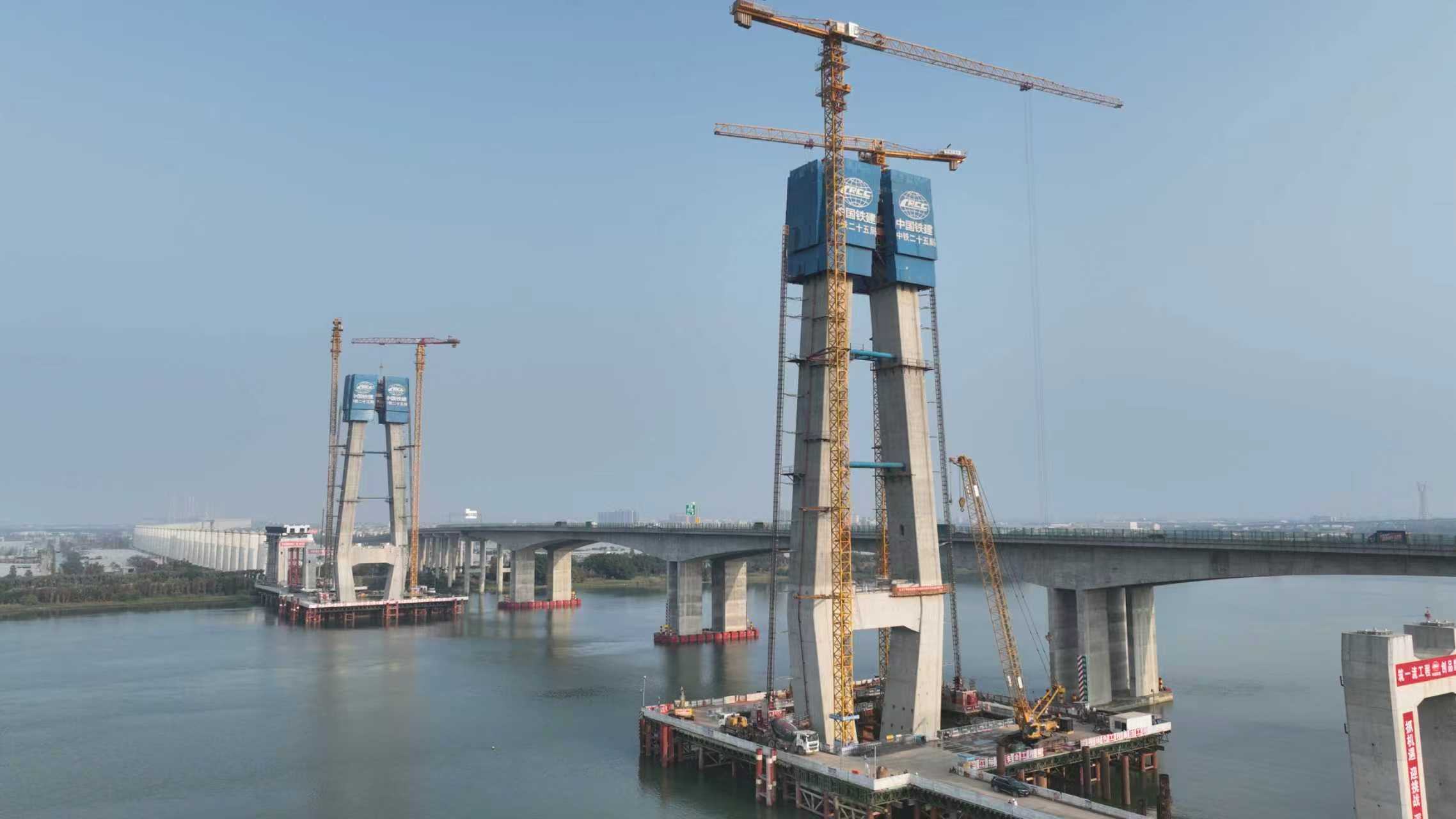
A view of the construction site of the cable-stayed bridge over the Tiger-Leaping Gate Waterway of the Shenzhen-Jiangmen Railway. Jan.29,2026.(Xinhua)
GUANGZHOU,Jan.29(Xinhua) On January 29, the construction height of the twin main towers (No. 17 and No. 18) of the Guangzhongjiang Grand Bridge's cable-stayed bridge spanning the Tiger-Leaping Gate Waterway—a major and challenging project of the Shenzhen-Jiangmen Railway constructed by China Railway 25th Bureau Group successfully surpassed the 100-meter mark. This milestone signifies that the twin towers have entered the final sprint stage of construction.
The main line of the Shenzhen-Jiangmen Railway is 116 kilometers long, with bridges and tunnels accounting for 98% of its total length. The CR25-built Section 12 of the railway primarily includes the construction of 13.41 kilometers of main line, the Jiangmen connecting line, the Jiangmen depot lead tracks and the station front works for the stabling yard, the erection of 455 double-track and 92 single-track beam spans, as well as track laying for the entire line. Among these, the main bridge of the Guangzhongjiang Grand Bridge spanning the Tiger-Leaping Gate Waterway is approximately 590 meters long, featuring a main span of 300 meters. The designed heights of its twin main towers are 131.5 meters and 140 meters, respectively.
According to Feng Haiqiang, the on-site project manager, the bridge construction area is situated within a Class I waterway, with nearly 300 vessels passing through daily. Moreover, the minimum distance to the existing Zhongshan-Yangjiang Expressway is only 30 meters, presenting significant safety risks and high technical requirements for construction.
To address these challenges, the project team has vigorously pursued technical innovation. They successfully overcame the difficulty of non-blasting excavation for the foundation of a large-span bridge in deep water with a bare rock bed—the first such case in China. By introducing an industry-leading intelligent tower-building machine and utilizing BIM (Building Information Modeling) technology, they achieved synchronous intelligent climbing, intelligent monitoring, and remote information management, ensuring safe and efficient construction. To tackle the challenges of high-altitude tower maintenance and crack prevention, the project implemented an intelligent maintenance system. This system integrates spray curing and curtain insulation functions, climbs synchronously with the working platform, enabling continuous moisturizing and temperature control of the concrete surface, thereby ensuring construction safety and quality.
It is reported that the Shenzhen-Jiangmen Railway is a crucial component of the Guangdong-Hong Kong-Macao Greater Bay Area's rail transit network. Upon completion, it will enable a 30-minute high-speed rail connection between the Qianhai Free Trade Zone in Shenzhen and the Nansha Free Trade Zone in Guangzhou. This will significantly reduce travel time, facilitate the flow of people and goods, bridge the geographical barrier of the Pearl River, promote balanced regional development, and contribute to building a coordinated "Golden Inner Bay." Simultaneously, it will radiate Shenzhen's advantageous resources, driving industrial upgrading and fostering diversified economic development along the route.